

Why Is My Heating Bill So High? (The Answer Usually Isn't Your Furnace)

Karen Danner • October 31, 2026

Share this article

Short answer: if your heating bill jumped and your furnace is working fine, you are almost certainly paying to heat air that is leaking out of the building. In most Nebraska homes the furnace is not the problem. The problem is that warm air escapes through the attic, the rim joist and the crawl space faster than the furnace can replace it, so the furnace runs longer to hold the same temperature. Sealing those leaks lowers the bill in a way that turning the thermostat down never will.

Every November we get the same phone call. The first real heating bill of the season shows up, it is a lot higher than anyone expected, and the question is whether the furnace is going out.

Usually it is not. Here is how to tell what you are actually dealing with.

What makes a heating bill go up when nothing changed?

Three things drive the number on that bill: how cold it is outside, what you pay per unit of fuel, and how fast your house loses the heat you just paid for.

You cannot control the weather and you cannot control the rate. The third one is the only part of the equation that is yours, and it is the one almost nobody looks at.

A house that leaks air has to be reheated constantly. The furnace cycles on, warms the room, the warm air rises and pushes out through gaps in the attic and the rim joist, cold air gets pulled in low to replace it, and the furnace kicks on again. That cycle runs all winter. The thermostat reads 70 the whole time, so nothing looks wrong, and the bill quietly reflects every one of those cycles.

How can I tell if my house is leaking air?

You do not need equipment for the first pass. Walk the house on a cold, windy day and look for these.

  • Cold floors. Especially over a crawl space or an unfinished basement. Cold floors mean cold air underneath.
  • One room that never gets warm. Usually a room over a garage, an addition, or a bonus room.
  • A furnace that runs almost continuously but never quite satisfies the thermostat.
  • Drafts near outlets, baseboards, and where the wall meets the floor. Hold the back of your hand there. If you feel movement, air is coming in from outside.
  • Dust collecting fast. Air moving through the building carries dust with it.
  • Ice dams or heavy icicles on the roof edge. That is heat escaping into the attic.

We went through the usual suspects in more detail in why is my house so drafty.

Isn't the fix just more insulation in the attic?

Adding insulation helps, but on its own it is often disappointing, and this is the part that surprises people.

Insulation slows heat moving through a surface. It does not stop air moving through a hole. Blow another foot of loose fill over an attic that has gaps around the light fixtures, the chimney chase and the attic hatch, and the air still goes straight through. You have slowed one kind of heat loss and done nothing about the other.

That is why a house can have plenty of insulation in the attic and still feel drafty and still cost a fortune to heat. We laid out the difference in air sealing versus insulation.

Closed-cell spray foam does both jobs in one pass, which is why it tends to show up on the bill faster than anything else we install. It expands into the gap, cures solid, and becomes the air barrier and the insulation at the same time.

Where does the money actually leak out of a Nebraska house?

In order of how often we find it, and roughly in order of what it costs you.

  1. The rim joist. The band of framing at the top of the foundation. It is usually either empty or stuffed with a fiberglass batt that air moves right past. It is the cheapest high-impact job we do. More on rim joists here.
  2. The crawl space. A vented crawl space is an open hole under your floor. Sealing it changes how the whole main floor feels.
  3. The attic plane. Every penetration through the ceiling, plus the hatch.
  4. Bonus rooms and additions built onto the original structure, where the framing joins up awkwardly.
  5. Attached garages, which pull cold into the rooms next to them.

How much will this actually save me?

We are not going to quote you a percentage, because anyone who does is guessing. Savings depend on the age of the house, where the leaks are, what fuel you burn, and how you live in the space.

What we will tell you is this. The homeowners who see the biggest change on their bill are the ones whose crawl space or rim joist was wide open, because that is a large area of raw heat loss sitting in one place. Those jobs are also usually the least expensive ones on the list, so the payback is the fastest.

When we come out we will tell you which of your problems is the expensive one, and whether it is worth the money to fix the rest. If one job gets you most of the way there, we will say so.

If you want the price ranges first, we published them in what spray foam insulation costs in Nebraska.

Frequently asked questions

Should I replace my furnace to lower my heating bill?

Not before you know how much heat the building is losing. A new high-efficiency furnace in a leaky house still has to heat the outdoors. If the shell is sealed first, you may find the furnace you have is sized just fine.

Does turning the thermostat down help?

A little, and it costs you comfort to get it. A leaky house loses heat in proportion to the difference between inside and outside, so dropping it a few degrees shaves a little off. Sealing the leaks changes the rate of loss itself, which is a much bigger lever.

Will new windows fix a high heating bill?

Windows are usually a small share of the total loss, and replacement windows are one of the most expensive things you can buy per unit of savings. Most houses we look at would get more out of a rim joist and crawl space for a fraction of the cost.

Can you do this in the middle of winter?

Yes. Rim joists, crawl spaces, basements and attics are all interior work, and we spray through the season. Winter is actually when it is easiest to find the leaks, because you can feel them.

How long does the work take?

Most residential jobs are one day. Larger whole-house projects can run two. The foam cures quickly and the space is usable the same day in most cases.

Find out where your money is going

If your bill went up and you cannot explain it, the answer is somewhere in the building, and it is usually in one of five places. We will come look, point at the actual spots, and give you a number.

The estimate is free and there is no pressure attached to it.

Request a free estimate or call us at 402-269-7058. We serve Syracuse, Lincoln, Nebraska City, Palmyra, Unadilla, Avoca, Elmwood, Weeping Water, Eagle, Louisville and the surrounding area.

Recent Posts

Nebraska farmhouse and outbuildings across a frost-covered field on a winter morning
By Karen Danner • October 31, 2026
Think spray foam has to wait for spring? It doesn't. See how winter installs actually work, which jobs make sense in the cold, and which ones we tell you to delay.
Thick icicles and a ridge of ice hanging from the snow-covered edge of a metal roof
By Karen Danner • October 31, 2026
Ice dams aren't a roofing problem, they're a heat problem. See what actually causes them, why more attic insulation often doesn't help, and the fix that lasts.

Frozen downspout buried in deep snow against a brick house foundation in winter
By Karen Danner • October 15, 2026
Frozen pipes aren't a furnace problem, they're an air leak problem. See where Nebraska pipes actually freeze, what to do tonight, and the one-time fix that works.

Classic older white two-story home with wraparound porch in late autumn
By Karen Danner • October 1, 2026
Think spray foam is only for new builds? Older Nebraska homes benefit most. See where foam goes in without opening walls—and why fall is the time to do it.

Woman wrapped in a blanket holding a warm mug inside a chilly, drafty home
By Karen Danner • September 15, 2026
Cold rooms and drafts showing up with fall? Most drafts aren't your windows. See where the leaks really are, what fixes them & how to stop high heating bills.

Combine harvester picking corn in a Nebraska field under a clear blue sky
By Karen Danner • September 1, 2026
Harvest is coming fast. See why early fall is the moment to fix condensation in grain storage, equipment sheds & livestock barns—before the season buries you.
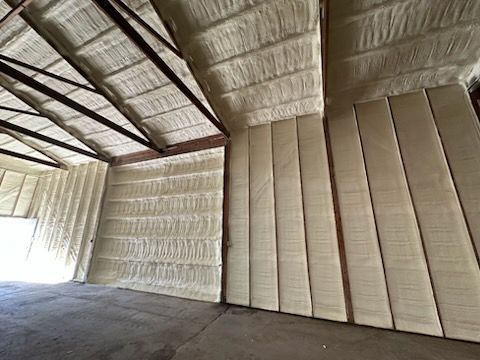
Building interior insulated with closed-cell spray foam by Danner Spray Foam
By Karen Danner • August 15, 2026
What drives the price of spray foam insulation in Nebraska? See the factors that shape your quote, why closed-cell is worth it, and how to get a free estimate.
A white two-story home framed by trees with colorful fall foliage in autumn
By Karen Danner • August 1, 2026
Building a shop, barn, or addition this fall? Here's why lining up spray foam in late summer means a warmer, drier space before Nebraska winter—and no scramble.

Blazing summer sun bursting through a bright blue sky on a hot day
By Karen Danner • July 15, 2026
Closed-cell spray foam isn't just for winter. See how it blocks summer heat, eases your AC, and keeps Nebraska homes, shops & garages cooler and cheaper to run.
Dark storm clouds gathering over farmland before severe weather
By Karen Danner • June 30, 2026
Nebraska storm season is hard on roofs and metal buildings. See how closed-cell spray foam adds rigidity, seals the deck against wind-driven rain, and helps protect your structure.
Show More